
Hetian jade, known as the “national jade” in traditional Chinese culture, has become a precious gem in the jewelry market due to its mild texture, profound color, and rich cultural heritage. Wearing a Hetian jade bracelet is not merely a form of adornment; it is also a manifestation of cultural inheritance, health preservation, and spiritual sustenance. This article will provide you with a comprehensive analysis of the charm of Hetian jade bracelets from four aspects: the benefits of wearing them, methods of playing with them, the symbolic meanings of the number of beads, and tips for distinguishing genuine from fake ones.
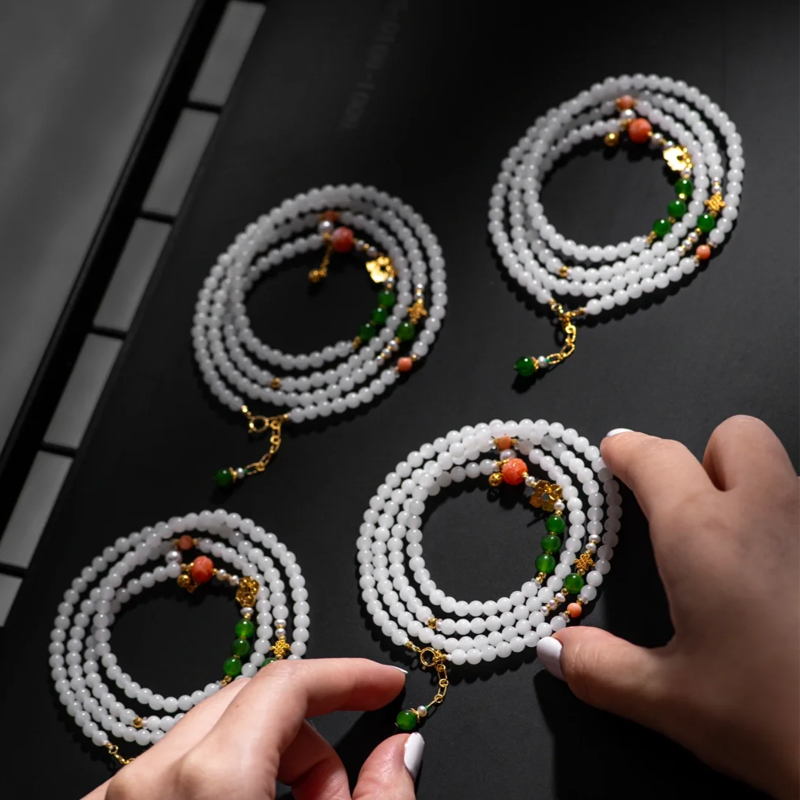
The Benefits of Wearing Hotan Jade Bracelets
In modern society, many friends wear a variety of bracelet ornaments, among which Hotan jade bracelets stand out as exceptional. Why do we say so? Let’s explore the benefits of wearing Hotan jade bracelets together!
Indicating Status
The character for “jade” (玉) is easy to understand at a glance. Remove the dot in the middle, and it becomes the character for “king” (王); place the dot above, and it becomes the character for “sovereign” (主). Both “king” and “sovereign” represent supreme authority. Thus, jade can be understood as the beautiful stone worn by kings around their waists, signifying its extraordinary nature. Possessing jade is equivalent to possessing status.
Additionally, there has been a saying since ancient times that “a gentleman should be like jade,” believing that jade possesses the five virtues of benevolence, righteousness, wisdom, courage, and purity. Only by embodying these noble qualities of jade can one become a gentleman. It is evident that those who wear jade are akin to gentlemen!
Aesthetic Appeal
Gold-inlaid jade, jade as beautiful as a fair face—jade has always been considered something extraordinary, associated with all things beautiful. Hotan jade, with its unique shape and outer skin, combines understated elegance with vibrant colors. It is round and lovely, crystal clear, and eye-catching!
Comfort
Visible yet seemingly intangible, it offers absolute comfort! Hotan jade is warm and smooth, making one feel as gentle as water when worn on the body. Moreover, jade can absorb impurities from the human body, nourishing the wearer!
Low Maintenance
Unlike gold and silver, Hotan jade requires almost no maintenance. It can be worn without removal even in spaces with marble or stainless steel surfaces, and its texture improves with wear!
Health and Stress Relief
Watching TV without something in your hands can be dull. Sitting in front of a computer, with your right hand clicking the mouse and your left hand idle, feels unbalanced! A jade bracelet is indeed a great companion for watching TV or working at a computer!
Auspiciousness
Seed jade bracelets are threaded through with a rope, symbolizing connectivity and representing the connection between heaven, earth, and humanity!
Versatility
Hotan jade bracelets are not only jade but also collectibles, playthings, fitness aids, ornaments, and works of art! Do not view any seed jade bracelet as merely the sum of the prices of a few “stones.” While one “stone” may be easy to find and two “stones” readily available, assembling a high-quality bracelet is no easy feat! This reflects its value.
Timeless Appeal
With a cultural heritage spanning five thousand years, jade exudes individuality without being ostentatious in any setting. Each piece is unique. Whether worn at work, during leisure, at gatherings, or at home, it never loses its elegance!
Appreciation in Value
With the extensive mining of Hotan jade, each piece becomes increasingly scarce, ensuring its appreciation in value due to its rarity. Therefore, a carefully selected Hotan jade bracelet will never disappoint; it has only the prospect of appreciation, with no reason for depreciation!
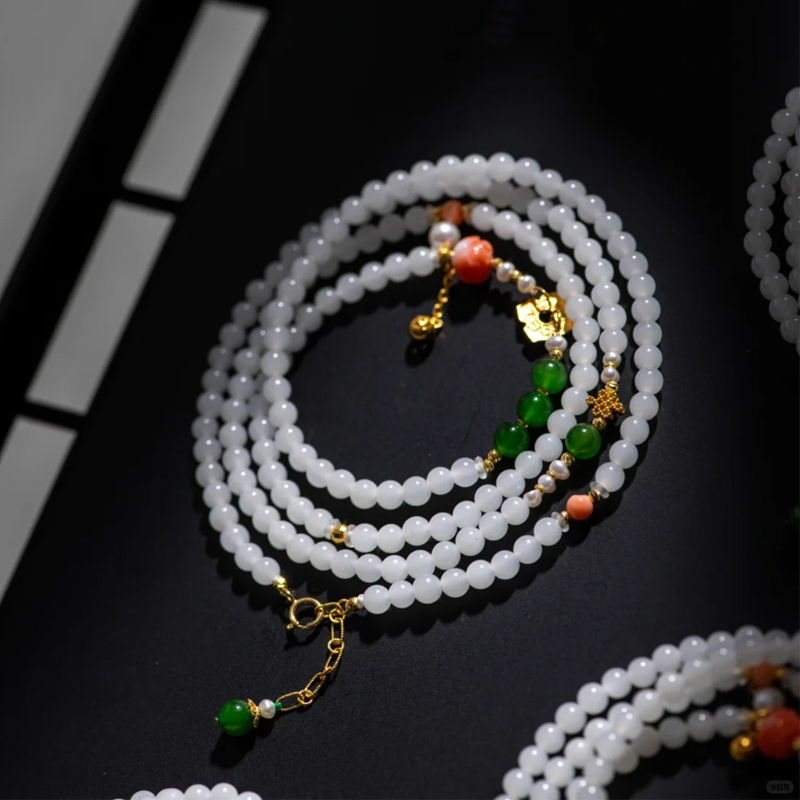
How to Play with a Hetian Jade Bracelet? Three Steps to Guide You!
Regarding the general way of playing with a Hetian jade bracelet, Mr. Zhao, a jewelry appraiser from Zhongyubaolin, is here to answer your questions today. You can refer to the following three steps:
Step 1: First, soak the entire Hetian jade bracelet in normal-temperature clean water for 2 to 3 hours to soften any surface attachments. Then, brush it clean with a toothbrush and place it in hot water to soak until the hot water and the jade cool down naturally. This allows the jade’s pores to fully expand and expel internal dirt. Repeat this process approximately three times, doing so about once every 3 to 6 months, or once every 1 to 2 months in summer.
Step 2: Before playing with the bracelet, make sure your hands are clean. For a more refined approach, you can wear white cotton gloves. Avoid playing with it when your hands are dirty, greasy, or sweaty. Some people rub the Hetian jade on their faces and noses to apply oil, but this actually has the opposite effect, sealing the jade’s pores and making the luster of the polished jade appear dull. When you no longer wish to play with it, use a soft, long, white, pure cotton towel to wipe each bead of the bracelet clean.
Step 3: After playing with the bracelet for a week in summer, soak it in warm clean water for a while and then brush it clean every night when you take a bath. However, be sure to avoid direct contact with soap. After that, simply keep the jade piece clean regularly.
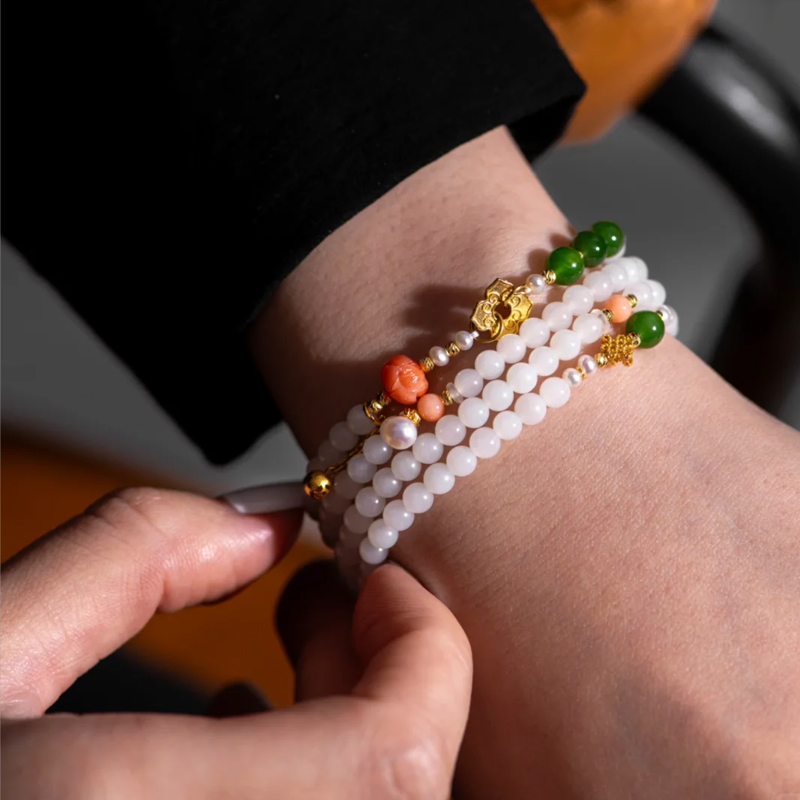
How Many Beads Are Appropriate for a Hetian Jade Bracelet? And What Are Their Respective Meanings?
In our daily lives, we often see bracelets that can be collected or worn as decorations. However, bracelets come with varying numbers of beads. How many beads are considered correct? What are their respective meanings? And how should they be worn? Do you know all this? Let’s learn about it together below.
Wearing Methods for Bracelets
Generally, people are accustomed to the saying “men wear on the left, women wear on the right,” but there are quite a few considerations when it comes to wearing bracelets.
The left hand represents enhancing luck, while the right hand represents warding off evil and averting misfortune.
Most people wear bracelets on their left hands because it is more convenient for daily activities.
On the other hand, the left hand is considered the “clean hand” that does not take life.
Therefore, it is recommended to wear bracelets on the left hand, which is relatively more suitable than the right hand.
Classification of Bead Bracelets and Considerations for Bead Count
For ordinary bracelets, you can simply count the beads. However, for Buddhist prayer beads, note that the guru bead, counter beads, and spacer beads are not included in the count. The meanings vary depending on the number of beads in the bracelet; some are auspicious, while others are not.
Bead bracelets come in different lengths and bead counts, and although nowadays people like to wrap them around their wrists regardless of length, these bracelets are actually categorized into hanging beads, holding beads, and wearing beads.
Hanging beads generally come in three types: 1080 beads, 108 beads, and 54 beads.
Holding beads generally come in four types: 36 beads, 27 beads, 21 beads, and 18 beads.
Wearing beads generally consist of 18, 14, 12, or even fewer beads.
Meanings of Different Bead Counts
One hundred and eight beads:
The 108-bead hanging bracelet is the most common, representing the quest to attain the 108 flavors of enlightenment and to be free from the 108 types of worldly troubles, including the ten fetters and ninety-eight afflictions. By cutting off these 108 troubles, one achieves spiritual liberation and physical tranquility.
Fifty-four beads:
The 54 beads represent the 54 stages in the bodhisattva’s path of cultivation, namely the “ten faiths, ten abodes, ten practices, ten grounds, ten redirections, and four roots of goodness.”
Thirty-six beads:
The 36-bead bracelet is relatively casual and easy to carry. It can also be understood as taking one-third of the 108 beads, simplifying the complex and seeing the big picture in the small, sharing the same meaning as the 108-bead bracelet.
Twenty-seven beads:
The 27 beads represent the cultivation of the twenty-seven Buddhist sages in the four directions and four fruits of the Hinayana school, namely the “eighteen learners” of the first four directions and three fruits, and the “nine non-learners” of the fourth arhat fruit, symbolizing “sages.”
Twenty-one beads:
Here, the 21 beads refer to the ten grounds, ten paramitas, and the fruit of Buddhahood. “The fruit of Buddhahood” means ultimately reaching the state of Buddhahood, symbolizing “rebirth” and overcoming recent difficulties.
Eighteen beads:
Commonly known as the “eighteen-bead bracelet” or representing the “eighteen arhats,” it refers to the “eighteen realms,” which are the six sense organs, six sense objects, and six consciousnesses. This is the most common bead count for bracelets, representing health and longevity. There are also many bracelets with 14 beads, especially favored by young women, symbolizing the fourteen fearlessnesses.
Twelve beads:
It is often compared to the “twelve links of dependent origination” mentioned in Buddhism, implying that one’s destiny is in their own hands.
There are many other bead counts and wearing methods; it’s ultimately a personal choice. While turning the beads, reciting “Namo Amitabha Buddha” can bring inner peace.
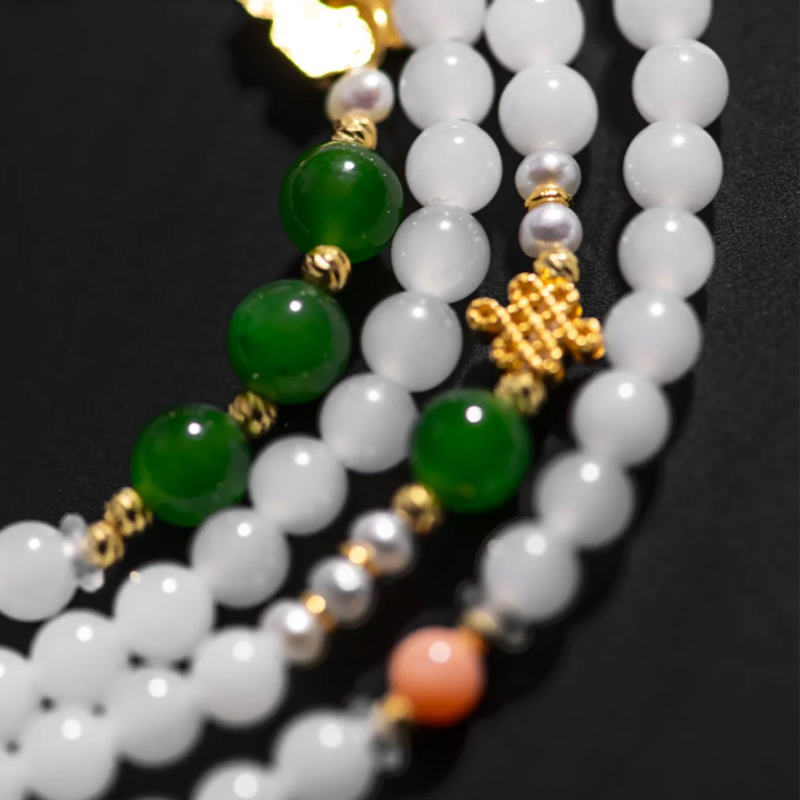
How to Identify Authentic Hetian Jade Bracelets: Six Methods for Discrimination and Purchase
Among the numerous types of Hetian jade, six are the most common and suitable for making cultural and ornamental bracelets: green jade, white jade, greyish-white jade, black jade, yellow jade, and sugar jade. Today, let’s learn how to distinguish the authenticity of these six types of Hetian jade bracelets and from which aspects to choose and purchase them.
I. Green Jade Bracelets
1. Identification of Green Jade Bracelets
Hand Touch Method: Hold the green jade bracelet in your hand and play with it a bit. If it feels oily and warm, it at least indicates that it is jade, but whether it is Hetian jade requires further comprehensive judgment based on other methods.
Glass Method: Hetian jade has relatively high hardness, at least higher than glass. Therefore, place the bracelet on glass; if it leaves scratches, it is likely Hetian jade.
Scratch Test: Use a pencil knife to scratch the bracelet. If it leaves obvious marks, it is probably not Hetian jade; if there are no marks, it is more likely to be Hetian jade.
Water Droplet Method: Hetian jade has relatively high density. Drop a water droplet on the surface of the bracelet; if the droplet does not disperse or slide off, it is Hetian jade.
Observation Method: The internal structure of genuine Hetian jade is very uniform and solid. Green jade is one of the few varieties of Hetian jade with transparency. Therefore, under sunlight, Hetian green jade should appear translucent with a solid structure.
2. Purchase of Green Jade Bracelets
Jade Quality: Whether purchasing any jade product, the quality of the jade is crucial. When buying a green jade bracelet, observe if the jade is fine, smooth, oily, and glossy, with a solid internal structure and small particles. If it is difficult to observe, use a strong flashlight.
Color: For green jade bracelets, the color should meet several standards: uniformity, purity, and vividness. If any of these conditions are not met, it will affect the overall value of the bracelet.
Black Spots: Hetian green jade often contains impurities, mostly in the form of black spots, which are considered flaws. If there are many such flaws, it will affect the overall value. Therefore, when buying a green jade bracelet, check if there are many or large black spots. If it is very pure without black spots, the quality is excellent.
II. White Jade Bracelets
1. Texture and Feel
White jade is a popular category among Hetian jade enthusiasts. Players value the fineness of the jade, its smooth feel, and gentle luster rather than a glaring shine. Therefore, when purchasing a white jade bracelet, weigh it, feel its texture, and observe its luster.
2. Appearance
Due to its strong toughness, white jade is less likely to chip during drilling. Therefore, when purchasing a white jade bracelet, check if there are any chipped edges around the holes. Other fake jades, such as quartzite, may show chipping. Also, observe the luster; white jade has a gentle, waxy luster rather than a glassy one. Additionally, check for very fine jade patterns in a cloud-like or misty structure.
III. Greyish-White Jade Bracelets
1. Touch Method
Genuine Hetian greyish-white jade feels cool to the touch, while fake jades do not have this sensation.
2. Observation Method
Under sunlight or other light sources, the internal color of greyish-white jade is very uniform, pure, and translucent, unlike other fake jades.
3. Licking Method
Genuine Hetian greyish-white jade feels astringent when licked with the tip of the tongue. If it feels very smooth, it is probably not greyish-white jade.
4. Water Test
Drop water on greyish-white jade; if the droplet remains intact without dispersing, it is genuine jade.
5. Magnification Method
Observe greyish-white jade under a magnifying glass; its internal structure is solid with small, evenly distributed particles, indicating good jade quality.
6.Color Observation
The color boundary between greyish-white jade and white jade is somewhat blurry, requiring experienced individuals to distinguish them accurately. Generally, if white jade has a bluish tint and is not as dark as blue jade, it can be considered greyish-white jade.
IV. Black Jade Bracelets
1. Color Observation
Whether it is jade or gemstones, the purer the color, the better. Therefore, when observing black jade bracelets, the darker and more ink-like the color, the better the quality.
2. Color Distribution
Color distribution refers to how the color is spread. Most black jades are not entirely black but have patchy black areas. Therefore, entirely black jade is the best, followed by patchy black, then speckled black, and finally scattered black.
3. Jade Quality
For jade bracelets, jade quality is always an unavoidable topic. Good jade quality indicates high value.
V. Yellow Jade Bracelets
1. Color Observation
Good yellow jade should have a vivid and bright color, such as golden yellow, followed by honey-wax yellow and lemon yellow. Yellow with a green or blue tint is less desirable.
2. Texture Observation
When purchasing a yellow jade bracelet, carefully check for flaws such as cracks, dirt spots, and impurities. A high-quality yellow jade bracelet should be free of these flaws.
3. Distinguishing Fakes
Many minerals resemble yellow jade in the cultural and ornamental circle. For example, yellow citrine may look similar at first glance, but yellow jade is heavier and has a more substantial feel than yellow citrine, which feels lighter. Other minerals to distinguish include yellow tourmaline, yellow wax stone, and yellow dragon jade. Later, I will compile an article on minerals easily confused with yellow jade.
VI. Sugar Jade Bracelets
The identification and purchase of sugar jade bracelets mainly focus on one characteristic: the sugar color. Generally, the (seeping color) of sugar jade penetrates from the outside in, even deeply. Fake sugar jade has a seeping color that floats on the surface, making it easy to distinguish. Therefore, when purchasing sugar jade, judge the depth of the seeping color from various aspects.