
What exactly is the difference between jadeite and jade? Many people, due to a lack of understanding of the concepts of “jadeite” and “jade,” mistakenly interpret “jade” as “jadeite.” For example, they might say they want to buy a “jade bracelet” when they actually mean a jadeite bracelet. Alternatively, they may mistakenly interpret “jade” as a specific type of jade stone and ask in confusion, “Which is better, jadeite or jade?”
一、What is “jade”?
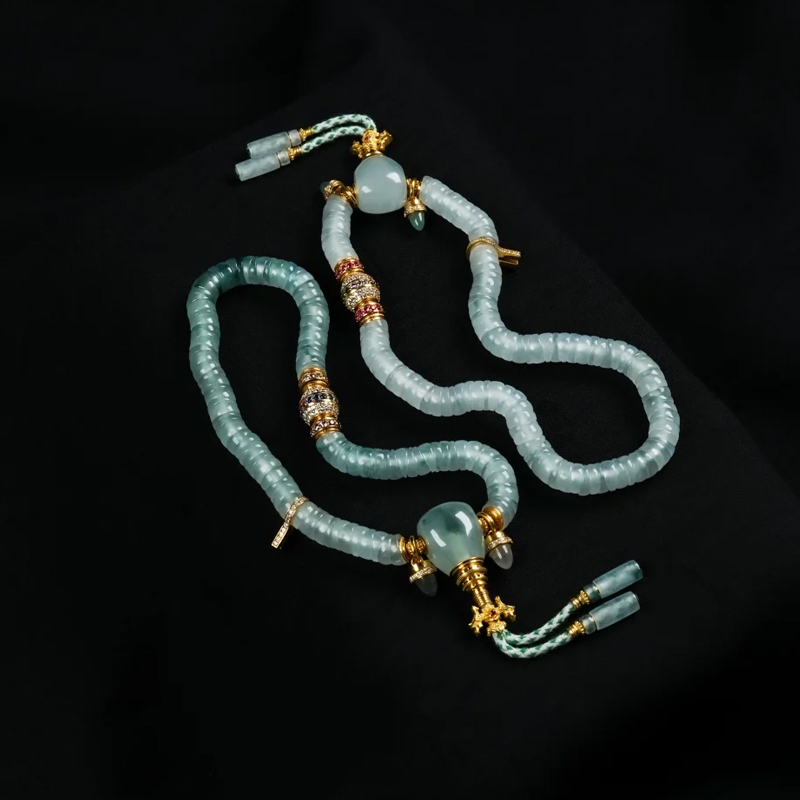
In the ancient text “Shuowen Jiezi,” it is described as “jade, the beautiful among stones,” meaning that any attractive stone can be broadly referred to as jade. According to the field of gemology and traditional Eastern thought, “jade” has a broad meaning, encompassing nephrite, jadeite, Xiuyan jade, Dushan jade, agate, turquoise, as well as quartz, Shoushan stone, chicken-blood stone, and so on.
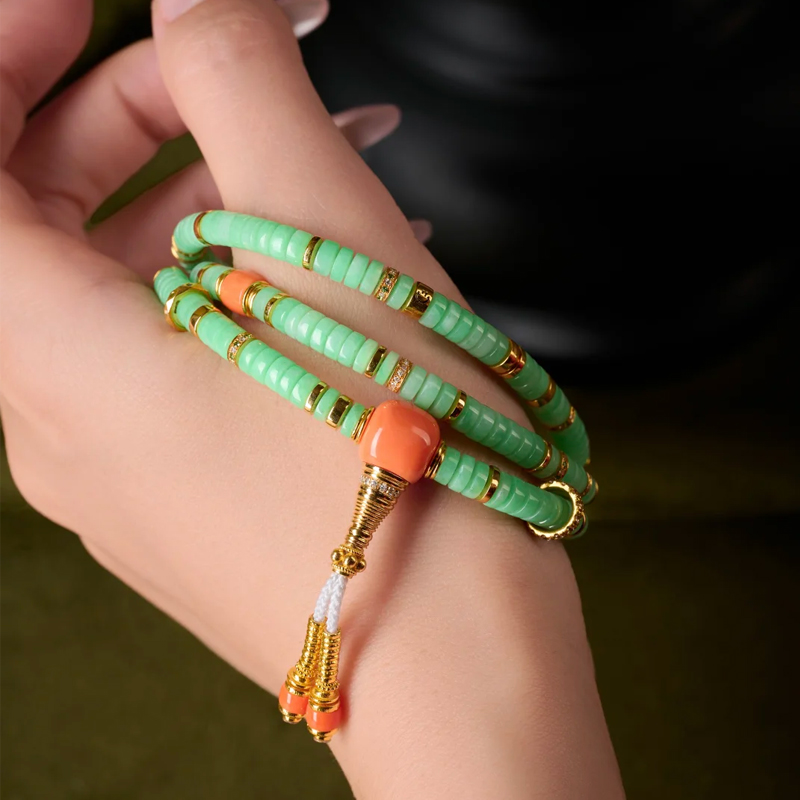
In folk or jade industry circles, “jade” can also be narrowly divided into nephrite and jadeite. Nephrite (hardness: 6.0-6.5) mainly refers to stones like Hetian jade and Kunlun jade, while jadeite (hardness: 6.5-7) refers to jadeite or jadeite rock.
In the industry of a specific type of jade, merchants may also refer to a particular type of jade simply as “jade.” For example, in the jadeite industry, jadeite is often referred to simply as “jade,” and similarly, in the Hetian jade industry, Hetian jade is also referred to simply as “jade.”
二、What is “jadeite”?
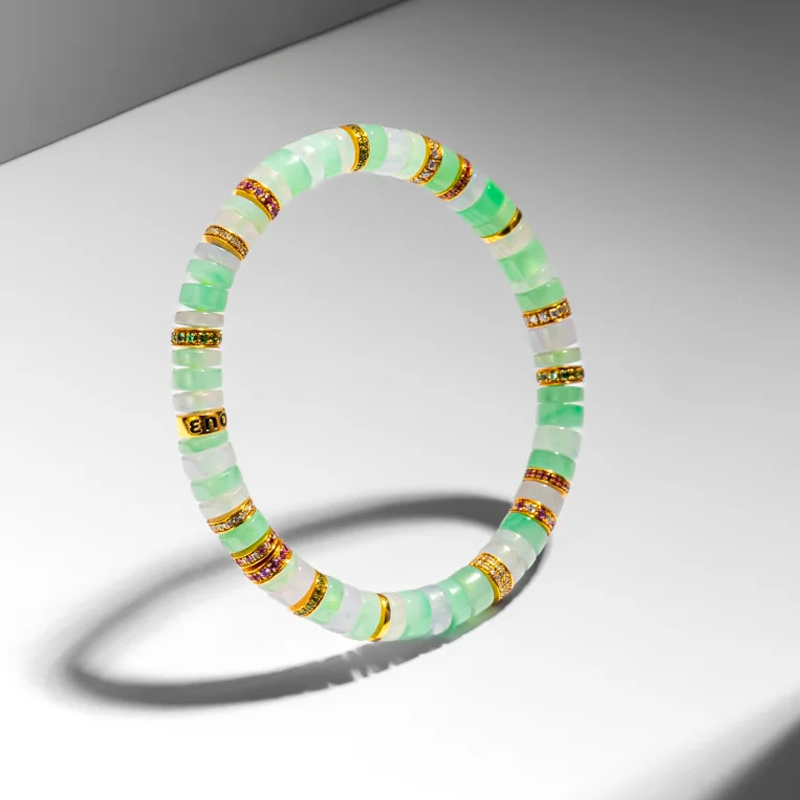
Jadeite is a specific variety among the many types of jade, primarily composed of a mineral aggregate dominated by jadeite.
When understanding the so-called jadeite from both petrological and commercial perspectives, there are some differences. From a petrological standpoint, jadeite is considered a type of rock because it is composed of the aforementioned multiple minerals and can be understood as a type of jadeite rock. When the content of omphacite is high, it can also be understood as omphacite rock. In commerce, jadeite refers to the collective term for gem-quality jadeite rock and omphacite rock that possess craftsmanship and commercial value. The name “jadeite” is derived from the jadeite bird, with red or yellow referred to as “fei” and green as “cui.” Jadeite with good texture and intense green color is known as “high-quality cui.”
三、The Conceptual Difference Between Jadeite and Jade
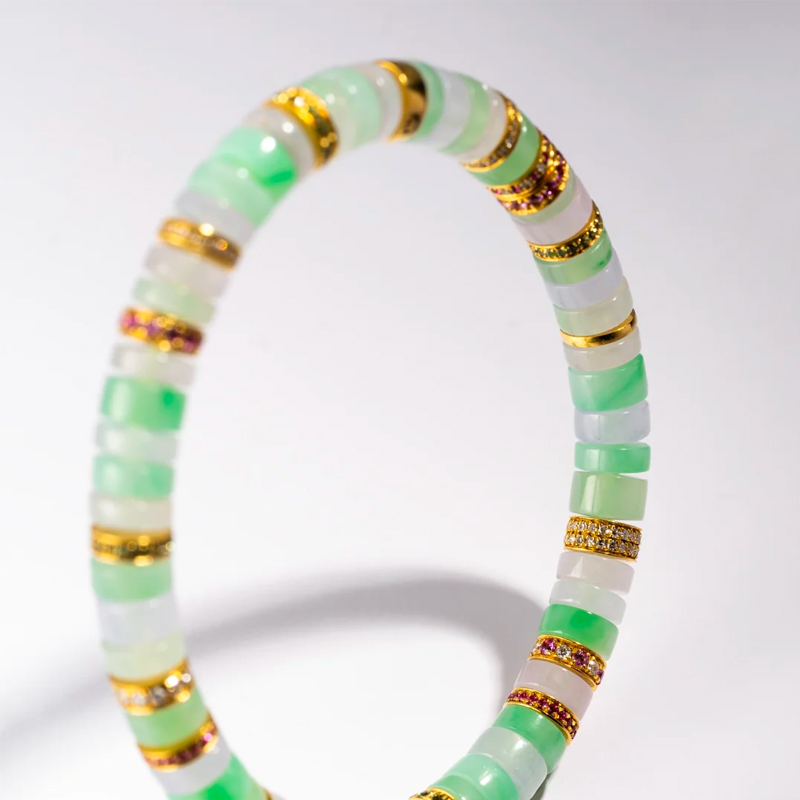
It can be said that jadeite is indeed a type of jade, but not all jade is necessarily jadeite. It is important to note that within the jadeite industry chain, operators often refer to “jadeite” simply as “jade,” such as buying and selling jade, engaging in the jade business, Myanmar jade, or jade bracelets. Jadeite operators understand each other implicitly, and in their minds, “jadeite” equals “jade.”
Jadeite is known as the king of jade and is the most internationally recognized gem-quality jade. It possesses characteristics and advantages unmatched by many other jade varieties. Specifically, jadeite has six notable characteristics: a rich variety of colors, stable physical properties, strong luster, high refractive index, high specific gravity, and high hardness. Additionally, gem-quality jadeite is only produced in specific mineral veins in Myanmar, and the uniqueness of its origin also determines its noble quality— “rarity makes value.”
四、Price Differences Between Jadeite and Jade
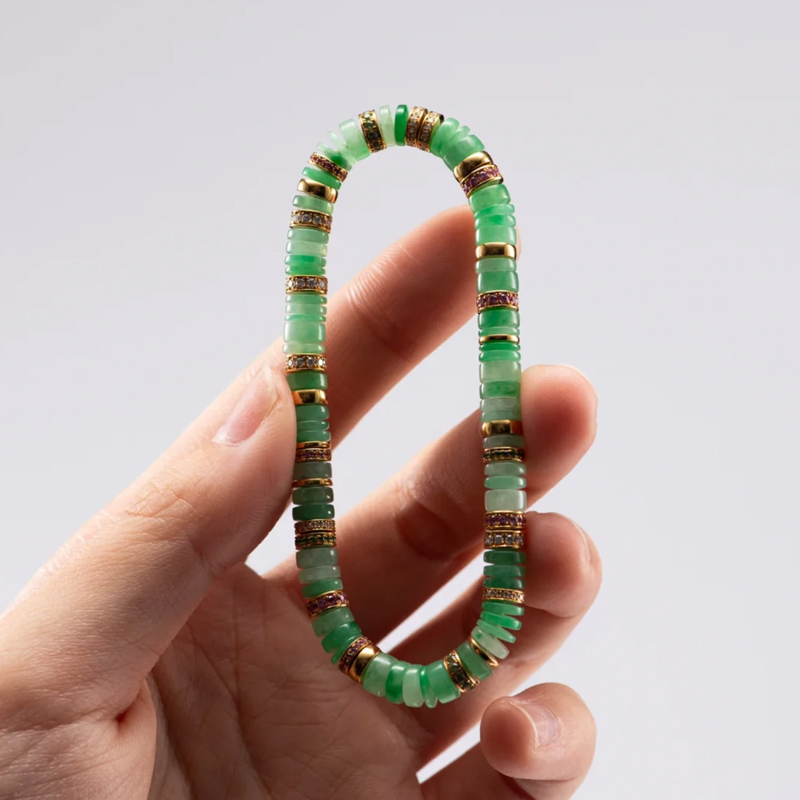
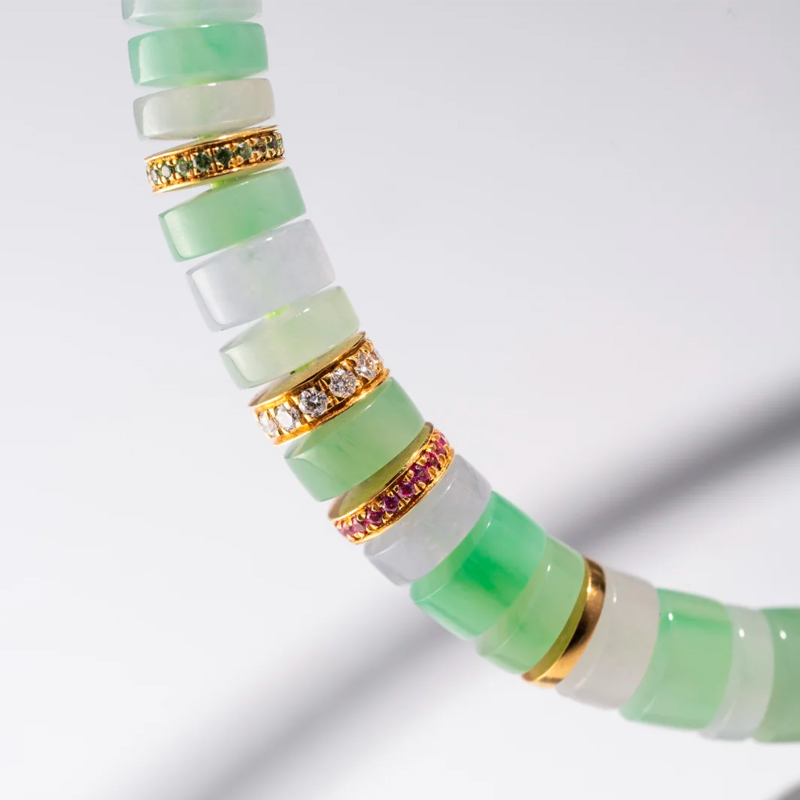
Overall, jadeite commands the highest prices among all types of jade. Sometimes, a single glass-seed full-green jadeite bracelet can fetch nearly ten million yuan, while jadeite necklaces can even reach hundreds of millions of yuan.
The 180 million yuan jadeite necklace. Hetian jade ranks second in terms of overall price. Apart from Hetian jade of average quality, high-quality Hetian jade can rival mid-to-high-grade jadeite in price. Due to its relatively small raw material size, Hetian jade is well-suited for crafting into bracelets. Consequently, a genuine Hetian jade bracelet made from mutton-fat jade can approach a price of one million yuan.
Of course, not all jadeite commands the highest prices. Some jadeite of poor quality can be quite inexpensive, with prices as low as a few dozen yuan, even lower than average-grade agate. Among all types of jade, it is possible for a low-grade variety of one type to be more expensive than a high-grade variety of another. Therefore, accurate price comparisons can only be made by examining specific specimens.
五、 Is Jadeite Better Than Jade?
Unless “jade” is understood to refer to a specific type of jade, the term generally encompasses all varieties of jade. If “jade” is used in this broad sense, then comparing jadeite to “jade” becomes meaningless, as it is based on a misunderstanding of the term “jade.”
When determining whether jadeite or jade is better, quality and personal preference are typically used as the criteria.
The quality of jade is inevitably linked to its physical and chemical properties. In the market, the quality of jade is reflected in its value or price. From a market perspective, the specific type or piece of jade with a higher price or value is considered better.
Hetian Jade Pendant
Additionally, personal preference is also an important factor in determining whether jade or jadeite is better. For example, some people prefer the masculine and strong qualities of jadeite, while others favor the gentle and delicate nature of Hetian jade.
六、 Differences Between Common Jade Varieties and Jadeite
Note: The following methods for distinguishing between jade and jadeite are for reference only and cannot guarantee 100% accuracy. To determine the specific type of jade, it is advisable to have it tested at a reputable jewelry appraisal institution.
Differences Between Jadeite and Nephrite
Jadeite is also known as “hard jade,” while the terms “soft jade” and “hard jade” are often inaccurately explained elsewhere. In fact, “soft jade” and “hard jade” are simply traditional terms and do not imply that soft jade is fragile or that hard jade is indestructible. Nephrite has a hardness of 6.0-6.5, while jadeite (hard jade) has a hardness of 6.5-7. Both have a fibrous interwoven structure, which is the densest and most stable structure. Nephrite can be classified into several important varieties based on color, including white jade, sapphire jade, jasper, black jade, topaz, and sugar jade.
(1) Luster is one of the most significant differences between jadeite and nephrite. Individuals with some experience can distinguish between the two by observing the reflected light. Nephrite exhibits an oily luster of varying intensity, which is soft and warm, leading to its perception as a warm-natured stone. In contrast, jadeite has a rigid glassy luster that conveys a sense of coldness, earning it the nickname “cold-hearted stone.”
(2) Physical properties: Nephrite has lower hardness (6.5), specific gravity (2.90), and refractive index (1.62) compared to jadeite (7/3.33/1.66).
Differences Between Jadeite and Malaysian Jade
The term “Malaysian jade” is often heard in the market or in daily life. However, Malaysian jade is not a natural, untreated stone but rather artificially dyed quartzite. Initially, unscrupulous merchants gave this dyed quartzite a deceptive name that has misled people for years: “Malaysian jade.”
Identifying Malaysian jade is relatively simple:
(1) Color: Malaysian jade is mostly green and is characterized by a渔网状 (fishing net-like) pattern when viewed under transmitted light. The green color is arranged in a regular pattern of small颗粒状 (granular) shapes resembling fish eggs. To the naked eye, Malaysian jade appears more vividly green than high-quality green jadeite, with a very uniform color distribution. (As shown in the figure below: The color distribution in jadeite does not have such a shape.)
(2) Concave curved surface: The bottom of Malaysian jade ring faces often exhibit a concave curved surface, a phenomenon not seen in jadeite.
(3) Specific gravity: Malaysian jade has a lower specific gravity and refractive index than jadeite. Individuals with some experience can distinguish between the two by hefting them in their hands or observing the reflected light.
Differences Between Jadeite and Australian Jade (Chrysoprase)
Australian jade is a type of chalcedony produced in Australia, also known as South Sea jade. Its color bears some resemblance to jadeite, but there are fundamental differences in color characteristics and distribution:
(1) Minerals: Australian jade is primarily composed of cryptocrystalline silica and is classified as chalcedony in mineralogy. Jadeite, on the other hand, is mainly composed of columnar or fibrous jadeite. Under a magnifying glass, the unique “jade texture” of jadeite can be observed.
(2) Color: Australian jade is either very uniformly colored or exhibits distinct parallel striped color bands. Its color is predominantly apple green and resembles plastic in appearance. In contrast, jadeite exhibits variations in color tone, and most jadeite, except for some uniformly colored varieties, displays “color roots.”
(3) Jadeite has a lower hardness but higher specific gravity and refractive index than Australian jade.
Differences Between Water Foam (Albite Jade) and Jadeite
Water foam is a mineral assemblage primarily composed of albite. Some water foam resembles jadeite, such as transparent or semi-transparent varieties that are similar in “seed water” quality to certain jadeite. However, there are fundamental differences between the two:
(1) Composition: The main mineral in water foam is albite, with its mineral crystals being granular. The fracture structure is similar to that of ordinary quartzite and does not exhibit the unique “jade texture” of jadeite.
(2) Luster: Due to its poor density and crystal structure, water foam has a weak reflective luster, with a glassy luster that has a slightly colloidal sheen. In contrast, jadeite has a pure glassy luster.
(3) Color: Water foam comes in various colors, but the color tones are generally weak and cannot match the best colors of jadeite.
(4) Hardness: Water foam has a lower hardness than jadeite and is therefore prone to scratches from other objects.
Differences Between Xiuyan Jade and Jadeite
Xiuyan jade is a native jade named after its origin in Xiuyan Manchu Autonomous County, Anshan City, Liaoning Province. It is one of the four most famous jades in China.
Xiuyan Jade Ornament
(1) Hardness test: Xiuyan jade has a significantly lower hardness than jadeite. Scratching the surface of Xiuyan jade with a sharp object will leave scratches, while jadeite will remain undamaged.
(2) Luster observation: Xiuyan jade has a distinct oily or waxy luster, while jadeite exhibits a glassy luster.
(3) Weight comparison: For Xiuyan jade and jadeite of the same volume, Xiuyan jade is slightly lighter than jadeite.