
As a representative of Eastern jewelry culture, jade bracelets serve not only as a symbol of status but also as a carrier of emotions and beliefs. However, given the wide price range in the market, from several hundred yuan to hundreds of thousands of yuan, how can one select a jade bracelet that meets one’s preferences? What significance does the number of beads hold? Where exactly do jade bracelets of different price ranges differ? This article will provide an in-depth analysis from a professional perspective.
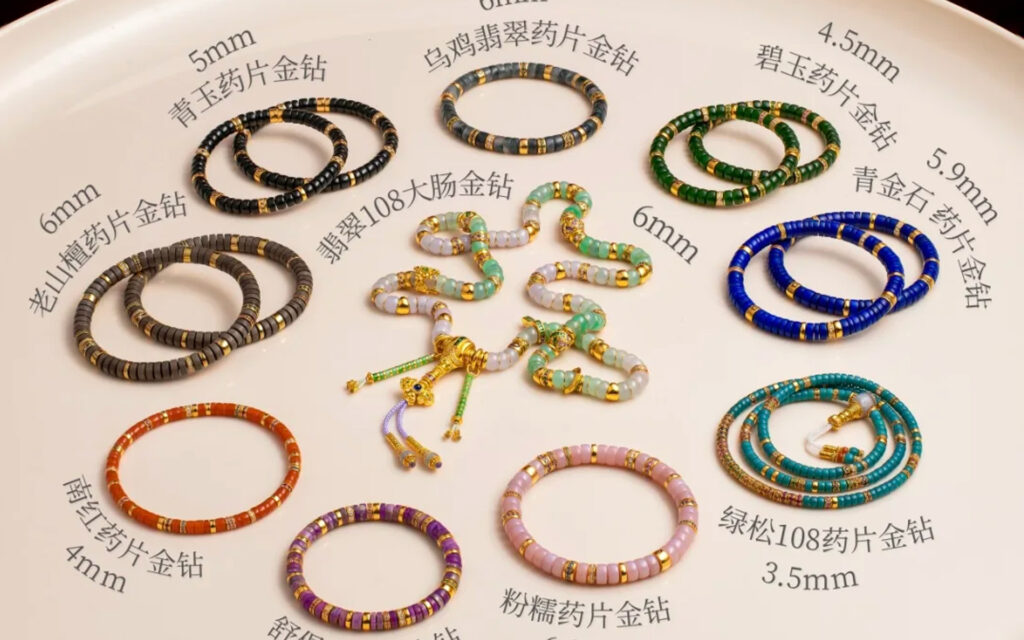
How to Select a Jade Bracelet That Meets Your Heart’s Desire?
As we all know, jade is an extremely precious gemstone, often referred to as the “King of Gemstones” in the jewelry industry. Due to its glass-like luster, delicate texture, and the highest hardness among gemstones, jade is easier to carve into exquisite ornaments.
Among jade products, common styles include rings, bracelets, beaded bracelets, pendants, and decorative pieces. Among them, the knowledge about jade beaded bracelets is not widely known, leading to confusion among people when selecting one, often wondering how to choose a cost-effective option. Some even believe that selecting an outstanding jade beaded bracelet can better showcase personal charm. So, how do you choose the right jade beaded bracelet? Generally, you can make a comprehensive judgment based on four aspects: the jade’s “seed and water,” color, flaws, and craftsmanship.
Examining the Seed and Water
In the jade industry, the term “seed and water” refers to the combination of the jade’s “seed” (texture) and “water” (transparency). The seed refers to the fineness of the jade’s flesh, while the water refers to its transparency. Since the seed and water of jade are synonymous with the quality of its flesh and are one of the key factors determining its price, it is essential to first examine the seed and water when selecting a jade beaded bracelet.
Jade can be classified from high to low in terms of seed and water as glass seed, ice seed, waxy seed, and bean seed, with glass seed being the highest quality. It is known as the oldest and most transparent jade and holds the highest value among jade varieties. Therefore, if a jade beaded bracelet can reach the glass seed level, its value is extremely high. However, glass seed jade beaded bracelets are rarely seen on the market, so one may have to settle for a lower grade.
If a jade beaded bracelet has good transparency, its price will be relatively higher. However, if its flesh is coarse, it will affect the price to some extent. Of course, fine flesh does not necessarily mean a high price unless the transparency is also good. Since transparency often has a greater impact on the value of a jade beaded bracelet than color, a colored bracelet without good seed does not qualify as high-end. Therefore, only when it has good seed and color can it be considered high-end.
Examining the Color
Jade comes in a variety of colors, including green, white, purple, blue, yellow, red, and black, with green being the most desirable. Since color is one of the key factors affecting the price of jade, a good jade beaded bracelet should meet the following color standards: pure, concentrated, vivid, and even.
Pure: Refers to the range of hues, determined by the proportion of primary to secondary colors. For example, pure green should not be mixed with other colors.
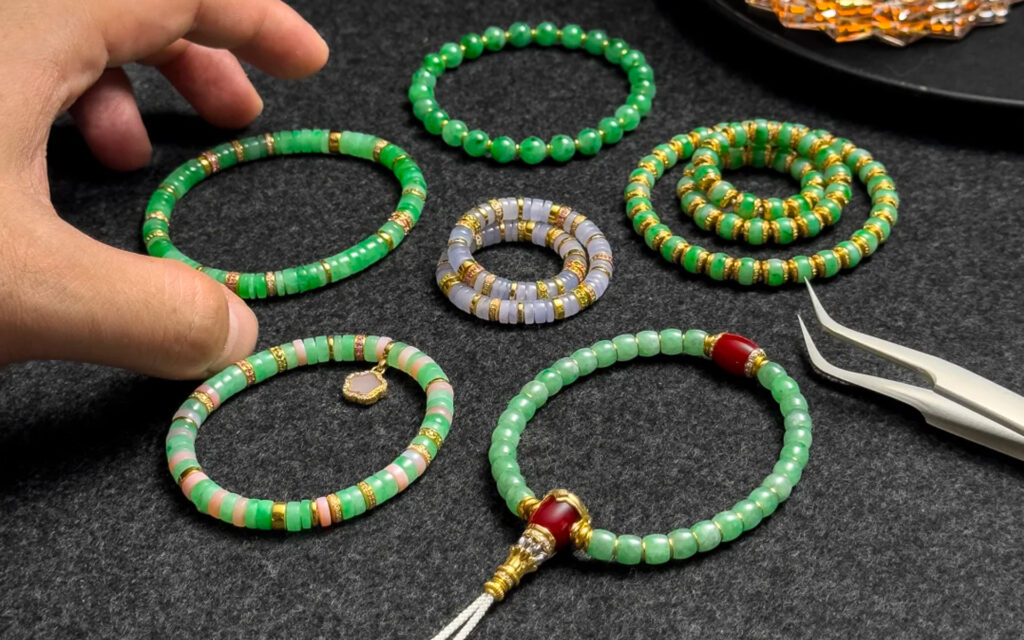
Concentrated: Refers to the depth of color. For green jade, the ideal concentration is between 70% and 80%.
Vivid: Refers to the brightness and vividness of the jade’s color, determined by the proportion of green to black or gray. The more vivid the jade, the higher its value.
Even: Refers to the uniformity of color distribution. Generally, jade has uneven color distribution, so jade with even color distribution is highly valuable.
Therefore, the best color for jade is pure green with a concentration between 70% and 80%, vivid and bright, and evenly distributed. This type of high-end jade is commonly referred to as “old pit seed” by experts.
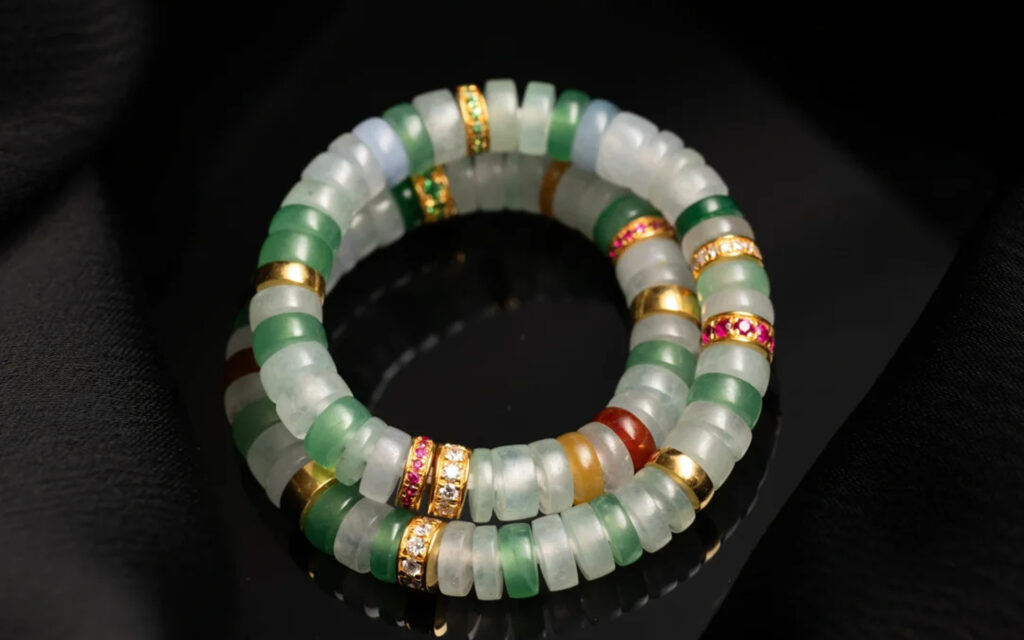
Additionally, jade usually comes in a single color, while jade beaded bracelets with two or more colors are relatively rare. The more color varieties a jade beaded bracelet has, the higher its price will naturally be.
Examining the Flaws
In fact, it is normal for natural jade to have flaws, as it has formed over hundreds of millions of years. However, regardless of the type of jade product, fewer flaws are always better. Generally, flaws can be classified as natural or man-made. Common flaws in jade include cotton, stone lines, jade characteristics, stone veins, stone flowers, discoloration, cracks, and fissures.
Flaws such as cotton, stone lines, and jade characteristics usually only affect the appearance of the jade beaded bracelet and have little impact on its price. Small flaws like stone veins, stone flowers, and discoloration are generally acceptable to most people. However, if the jade has cracks or fissures, it will not only affect its appearance but also reduce its value.
Of course, different people have different understandings of flaws. For example, in the jade industry, cracks and fissures are generally considered flaws, while jade characteristics are not. Stone lines, stone flowers, and discoloration are considered flaws if they are severe enough to affect the beauty of the original piece, but not if they are mild and do not significantly affect the appearance of the jade beaded bracelet.
Therefore, we must view flaws in jade beaded bracelets rationally and not generalize.
Examining the Craftsmanship
The materials and craftsmanship used to make jade beaded bracelets are usually quite demanding and test the skills of jade carvers. For example, the surface of the beads should be smooth, the lines should be fluid, and the sizes should be consistent. Nowadays, the Buddhist connotations of jade beaded bracelets have gradually faded, and each bead is no longer plain and unadorned. In addition to carving images of Arhats, beads are also made into various lifelike shapes to meet the pursuits of jade enthusiasts.
Therefore, the better the carving and polishing techniques of a jade beaded bracelet, the higher its market value will be. Additionally, if the jade beaded bracelet is designed and carved by a renowned master, its price will also be relatively higher.
In short, selecting a jade beaded bracelet that meets your heart’s desire is not difficult. As long as you master these four points, you will naturally be able to do so with ease.
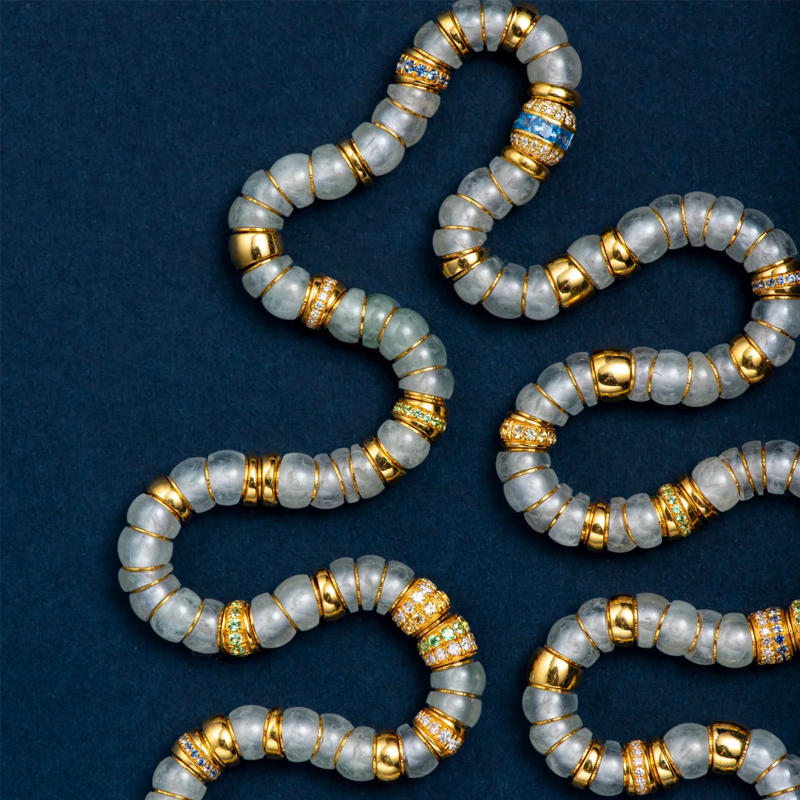
How Many Beads Are Typically in a Jade Bead String? (The Symbolism of Jade Bead String Necklaces)
Jade, known as the “King of Gemstones,” is a favorite in the jade market! Bracelets, necklaces, bead strings, and other forms are highly sought after by numerous women, especially bead strings, which can accentuate a woman’s agility and delicacy. However, how much do you know about the symbolism of different bead strings?
How many beads should a jade bead string have?
There is no strict rule regarding the number of jade beads to wear; it depends on the bead size and the normal wrist-wearing size. For women’s styles with 4-6mm beads, there are typically 25-30 beads, while for men’s styles, there are 35-40 beads. For 8mm beads, women’s styles usually have 18-25 beads, and men’s styles have 22-30 beads. For 12mm beads, women’s styles typically have 10-12 beads, and men’s styles have 12-16 beads.
In ancient times, every bead string was a masterpiece and would be considered very precious gemstones today, extremely valuable. Jade bead strings first became popular among the upper class in the Qing Dynasty. Compared to bracelets, the imperial concubines in the Qing Palace preferred the jade “eighteen-bead string.”
On one hand, Buddhism was revered in the Qing Palace, and with the monotonous life in the harem, chanting scriptures and praying became a hobby for the concubines to pass the time. On the other hand, in the harem, a mother’s status rose with the birth of a son. The concubines particularly hoped to give birth to princes and referred to the beads on the string as “children,” hoping for many children and blessings.
The Symbolism of the Number of Beads in Jade Bead Strings
One bead: Represents “Eka-rasa-skandha” in Sanskrit, meaning a subtle consciousness that has continued unchanged since time immemorial. It is the subject of reincarnation, possessing the four aggregates of sensation, perception, mental formation, and consciousness, which blend and transform into one taste, similar to the concept of the atman in Brahmanism.
Two beads: Represents harmony (generally, pairs are considered harmonious numbers, similar to the concept of yin and yang in pairs).
Three beads: Refer to the Three Treasures: Buddha, Dharma, and Sangha.
Four beads: Refer to the Four Conditions: cause and condition, sequential condition, condition of conditions, and predominant condition (old translation); cause and condition, equal continuous condition, object condition, and predominant condition (new translation).
Five beads: Refer to the Five Vehicles: human vehicle, heavenly vehicle, Sravaka vehicle, Pratyekabuddha vehicle, and Bodhisattva vehicle.
Six beads: Refer to the Six Gates: the six senses of eye, ear, nose, tongue, body, and mind, also known as the six gates.
Seven beads: Refer to the Seven Excellent Dharma: also known as the seven methods, seven knowledges, seven virtues, or seven excellent methods. They include knowing the dharma, knowing the meaning, knowing the time, being content, knowing oneself, knowing the crowd, and knowing hierarchy.
Eight beads: Refer to the Eightfold Path.
Nine beads: Refer to the nine ages: past, future, and present, each with three ages, totaling nine ages.
Ten beads: Refer to the ten benefits: various ten benefits scattered throughout the sutras.
Eleven beads: Refer to the eleven powers: the eleven kinds of power with which Amitabha Buddha blesses those who practice reciting the Buddha’s name. They include great compassion power, great vow power, great wisdom power, great samadhi power, great majestic power, great power to overcome evil, great power to subdue demons, power of distant vision with the divine eye, power of distant hearing with the divine ear, power to thoroughly perceive others’ minds, and power of universal illumination to gather sentient beings. With these eleven powers, all magical obstacles are removed.
Twelve beads: Refer to the twelve links of dependent origination.
Thirteen beads: Refer to the thirteen powers: the power of cause, the power of condition, the power of intention, the power of vow, the power of expedient means, the power of constancy, the power of virtue, the power of concentration, the power of wisdom, the power of extensive learning, the power of upholding precepts, patience, diligence, and meditation, and the power of right mindfulness and right view leading to various penetrating insights, i.e., the power to achieve right mindfulness and right view leading to the six supernatural powers and three insights. The thirteenth power is the power to subdue all sentient beings in accordance with the dharma.
Fourteen beads: Represent the fourteen fearlessnesses of Guanyin Bodhisattva.
Fifteen beads: Refer to the fifteen deities that should be arranged on the body of a true word practitioner.
Sixteen beads: Refer to the sixteen yaksha benevolent deities that guard the Prajna Sutra and its reciters.
Seventeen beads: Refer to the seventeen pure lands.
Eighteen beads: Have the same meaning as 108 beads but are divided into six parts for convenience of carrying, symbolizing greatness within smallness.
Nineteen beads: Refer to the nineteen teachings: Guanyin Bodhisattva manifests nineteen different bodies to teach according to the needs of sentient beings.
Twenty beads: Refer to the twenty powers: the twelve kinds of utilization possessed by a bodhisattva.
Jade bead necklaces commonly seen in the jade market, priced at several hundred to several thousand yuan, belong to the category of common流通 (circulating) items and do not have much collection value. One can simply buy them if they like and wear them as ordinary ornaments.
Truly valuable for collection are green and purple bead necklaces. The beads must have a certain diameter, with overall bright and vivid colors, harmonious sizes, and good quality.
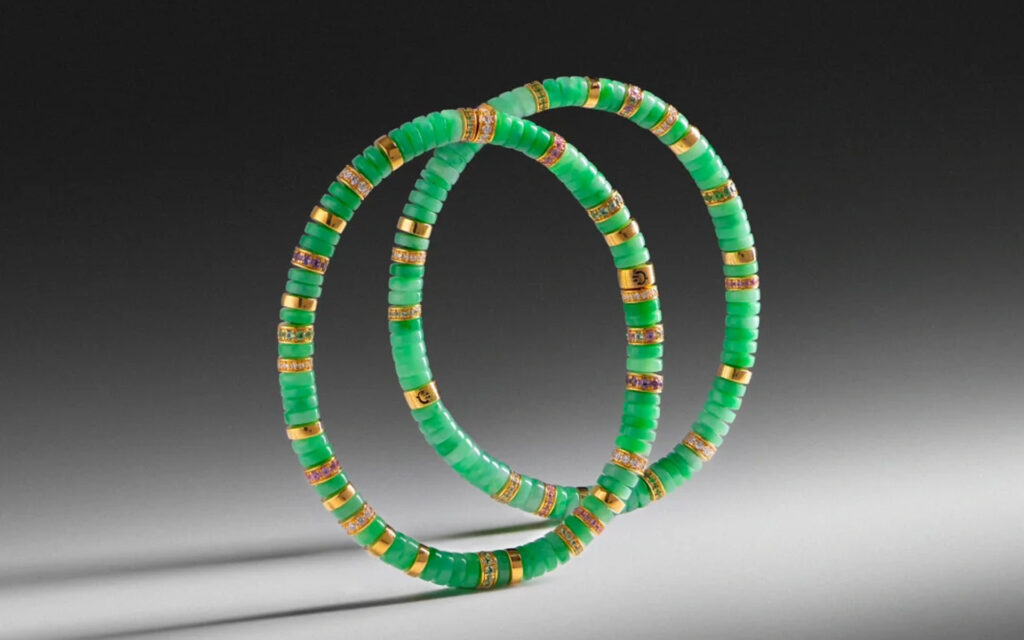
Essential Knowledge! What Exactly Are the Differences Between 0.5K Yuan and 50K Yuan Jadeite?
As the saying goes, “You get what you pay for.” This means that even for the same item, different prices will reflect different qualities, and this is particularly evident when it comes to jadeite.
You can buy jadeite for 500 yuan, and you can also buy jadeite for 50,000 yuan. But where exactly do the differences lie between the two?
Difference 1: Seed and Water Content
The most direct manifestation of the difference in jadeite prices lies in its seed and water content. Even for laypeople, jadeite priced at several hundred yuan and that priced at tens of thousands of yuan can be easily distinguished at a glance due to the significant difference in their seed and water content.
With similar styles, jadeite worth several hundred yuan does not appear “lustrous.” The crystal structure of such jadeite is generally relatively rough, giving it a dry appearance.
On the other hand, jadeite worth tens of thousands of yuan has much better seed and water content. The base of these jadeite pieces is relatively fine, giving a “watery and moist” feeling. In terms of appearance, they far surpass jadeite in the hundred-yuan price range.
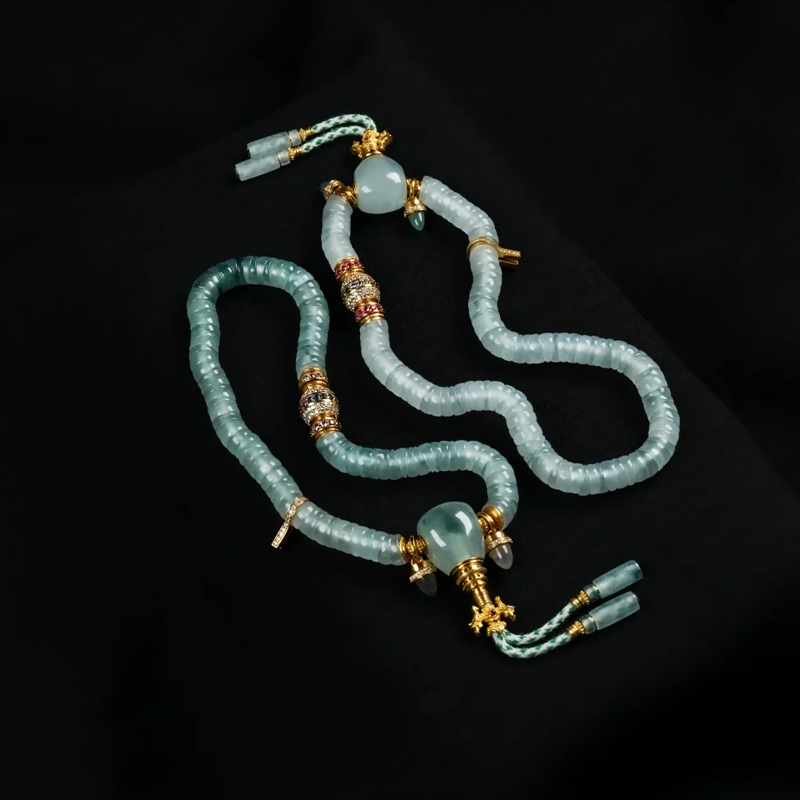
Difference 2: Color
Apart from seed and water content, color is also an important factor distinguishing the price levels of jadeite. After all, among the many jadeite enthusiasts, many are “color lovers”!
Generally, jadeite in the hundred-yuan price range mostly has light colors, although green does exist. There are two types of green: dry green and grayish green.
In contrast, the green in jadeite worth tens of thousands of yuan is much more vivid, with higher transparency and saturation. Such jadeite colors appear more lively and vibrant.
Difference 3: Style
Would you believe it if I said you could buy glass-seed jadeite for several hundred yuan? It’s true! This is because the price differences between jadeite pieces of different styles can be enormous.
With the same quality, the larger the size of the jadeite, the more valuable it is. Due to their style, jadeite bangles are very material-intensive, and their prices are naturally the highest.
So, can you really buy glass-seed jadeite for several hundred yuan as mentioned earlier? It’s impossible for bangles, but it’s possible for other styles such as very small freeform or cabochon pieces. Such small glass-seed jadeite pieces can be purchased for several hundred yuan and used for inlaying into earrings or pendants, which is also a great choice.
Difference 4: Flaws
As a natural product of nature, jadeite inevitably has some flaws to varying degrees. The higher the price, the fewer and less conspicuous the flaws will be.
Compared to flawless jadeite, jadeite with cracks will suffer a significant drop in value. Among all flaws, cracks are the most fatal as they not only damage the structure of the jadeite but also deprive it of any appreciation potential.
Taking jadeite bangles as an example, a complete jadeite bangle with decent seed and water content and color can easily fetch a price of tens of thousands of yuan or even higher. However, if there are cracks present, it will be difficult to sell, no matter how good the seed, water content, and color are.
If a jadeite bangle accidentally breaks, its price will drop significantly. However, such a bangle can still have high cost-effectiveness as a decorative item if it is repurchased and repaired with gold wrapping.