
Many beginners love Hotan jade but are hesitant to make a purchase. They’re afraid of buying fakes, paying too much, or getting confused by sellers’ sales pitches. Online information is scattered and disjointed, making it harder to understand the more you read. In this article, we’ll skip the mystique and cut through the hype, starting from scratch to clearly explain the key points of selecting a bracelet. After reading this, you’ll be able to avoid at least 80% of the pitfalls on the market.
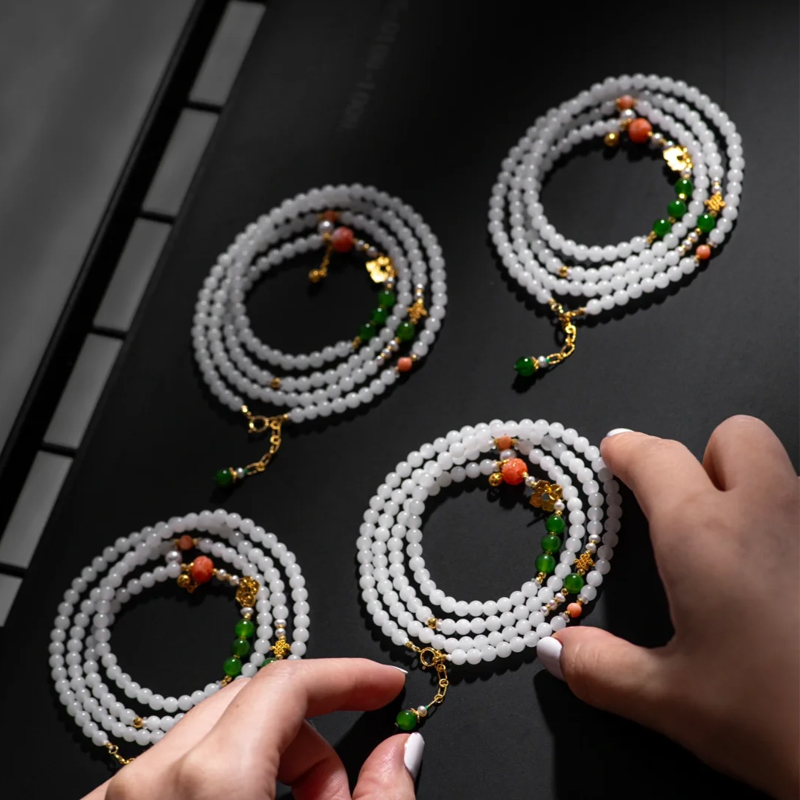
I. First, Understand the Basics: What Exactly Is Hotan Jade?
A common misconception is that “only jade from Hotan, Xinjiang, is genuine Hotan jade.”
This belief is long outdated. Since 2003, national jewelry standards have clearly stipulated that “Hotan jade” refers to a type of jade, not a specific place of origin. As long as the primary component is tremolite and the content meets the required standards, it’s called Hotan jade—regardless of whether it comes from Xinjiang, Qinghai, Russia, or South Korea.
99% of the Hotan jade on the market comes from four sources:
Xinjiang jade is the traditional benchmark; its oiliness and glutinous texture are the best among all origins. It feels warm and understated to the touch, though prices are generally on the higher side. Among these, the “zi” jade from the Yulong Kashgar River represents the top tier of Hotan jade.
Russian jade is exceptionally white, with a clean texture, high production volume, and excellent value for money; 80% of the white jade bracelets on the market are made from Russian jade. The downside is that some pieces tend to be “stiff and white,” and their oiliness is slightly weaker than that of Xinjiang jade.
Qinghai jade has ample translucency and tends to be quite transparent, often featuring water lines and a clear, bright color, all at an affordable price. Top-tier varieties such as Yeinugou, Lotus Root Powder, and Qing Shui have gained significant popularity in recent years.
Korean jade has a coarser texture, often with a greenish-yellow hue, lacks oiliness, and is the least expensive. The low-priced Hotan jade on the market—costing tens or hundreds of yuan—is almost exclusively Korean jade.
Beginners need not dwell on the origin; the quality of the jade is what truly matters.
II. The Collector’s Guide: Start by Examining Two Key Metrics
When beginners are buying Hotan jade bracelets, rather than getting hung up on the origin or whiteness, they should first focus on two key metrics: bead diameter and oiliness. Understanding these two points can help you avoid most pitfalls.
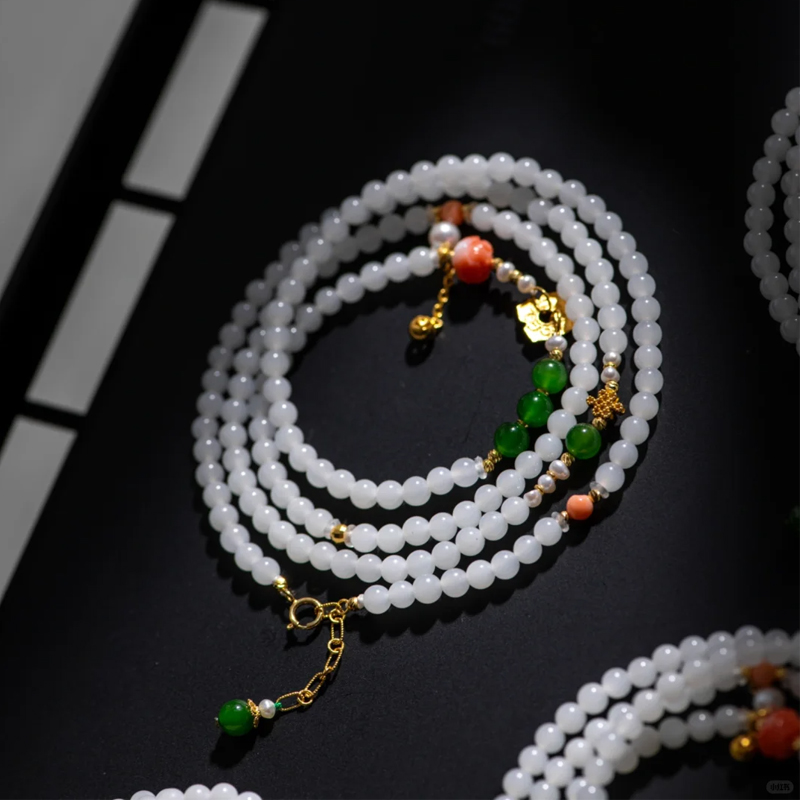
Oiliness is the soul of Hotan jade.
When many beginners get their hands on a bracelet, their first instinct is to check how white it is. This is a huge misconception.
The core quality of Hotan jade lies in its fine texture and oily luster. High-quality Hotan jade feels warm and smooth to the touch, and its oily luster becomes increasingly apparent with handling; ordinary-quality material often feels dry and涩, appearing whitish and lacking that creamy, creamy texture.
How do you judge oiliness? There’s a simple method: feel it with your hands. Material with ample oiliness feels as if it has a thin layer of oil on it, even though your fingers are dry; it becomes increasingly smooth after a few minutes of handling. Beads that rely solely on polishing, on the other hand, feel very slippery at first but become rough after prolonged handling. This is what experienced collectors often refer to as “the fake luster fades, revealing its true nature.”
Whiteness isn’t necessarily better the whiter it is. If it’s only white without oiliness, it’s a stiff, lifeless white that won’t develop any character through handling. It’s better to choose a greenish-white jade with a lustrous sheen than a dry, white jade. Bracelets are meant to be handled, and oiliness has a greater impact on long-term enjoyment than whiteness.
Choose the Right Bead Size for Comfort
When beginners select bracelets, bead size is often the first detail they overlook. Many focus only on the total number of beads in the bracelet, neglecting the size of individual beads, resulting in a bracelet that looks extremely disproportionate when worn.
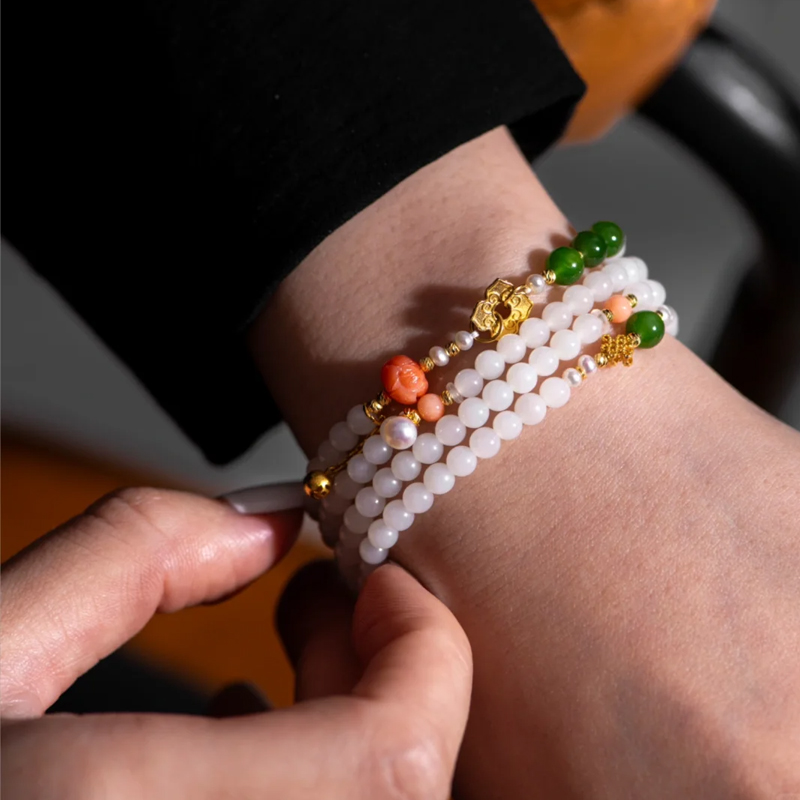
Generally speaking, for women with wrist circumferences between 14 and 16 centimeters, a single-strand bracelet with 6- to 8-millimeter beads is very versatile. For men with wrist circumferences between 17 and 19 centimeters, 10- to 12-millimeter beads look more elegant. If you prefer layering multiple strands, 4- to 5-millimeter “rice-grain” beads are a popular choice.
Only when the bead diameter is chosen correctly will the bracelet fit well; only when the size is right will you grow to love it more the more you wear it.
III. How to Choose a Bead Shape? A Comprehensive Guide to the Characteristics of Each Style
Hotan jade bracelets come in a wide variety of bead shapes, each with its own unique charm.
Round beads are the most classic shape, often described as “round and lustrous.” Round beads best showcase the warm, lustrous texture of Hotan jade. They symbolize “completeness and fulfillment,” hold stable value, and are the top choice for creating collector-grade bracelets made from premium materials. Round beads demand high-quality raw material; only large pieces with a high degree of perfection can be carved into them. If one were to point out a drawback, it would be that they are relatively difficult to shape into a perfect sphere and require a significant amount of material.
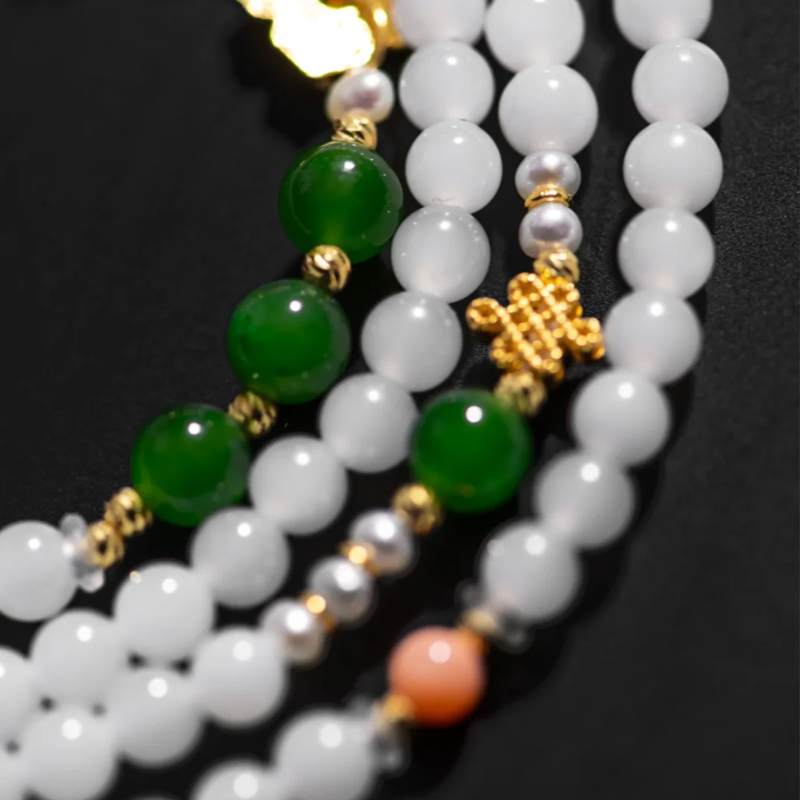
“Old-style” beads have become particularly popular in recent years. Resembling small barrels, they have flat ends, a slightly bulging center, and clean, crisp lines. Compared to round beads, they exude a more refined and scholarly elegance; they fit snugly against the skin without catching body hair, and possess a calm, dignified aura. The raw material requirements for old-style beads are even more stringent than those for round beads. Old-style beads measuring 8 to 12 millimeters are considered the most suitable.
Straight-cut beads are a new style introduced to the jade community by the cultural collectibles scene in recent years. The ends of the beads are cut flat, creating bold, defined lines. The beads fit together almost seamlessly, with excellent roundness and a strong sense of unity, giving them the appearance of a single bracelet. However, straight-cut beads have one widely acknowledged drawback—they catch on body hair. They are not suitable for larger sizes.
Naturally-shaped beads preserve the raw jade’s natural form, with each small bead being one-of-a-kind. It often takes a long time to assemble a full strand of small, unpolished, unmodified, and flawless beads. Naturally-shaped bracelets typically retain their natural skin and even impact craters, giving them a wild, rugged look that is particularly well-suited for men.
Other shapes include apple beads, barrel beads, abacus beads, pill-shaped beads, carved beads, and more. Apple beads are a variation of the traditional style, with a slightly rounder shape; abacus beads are among the most comfortable to wear and least likely to snag body hair; and carved beads feature a rich variety of themes and exquisite craftsmanship. The best bead shape is the one you like best.
IV. How to Choose Based on Your Budget? Spend Your Money Wisely
For budgets under 1,000 yuan, prioritize categories such as green jade, “clear water” jade, and ordinary nephrite. Pay close attention to the brand’s quality control and authenticity certificates. At this price point, you can purchase entry-level bracelets from reputable brands that meet your daily wearing needs. Avoid chasing after concepts like “mutton-fat white jade” or “seed jade”—low-priced products of this kind often carry the risk of mislabeled materials.
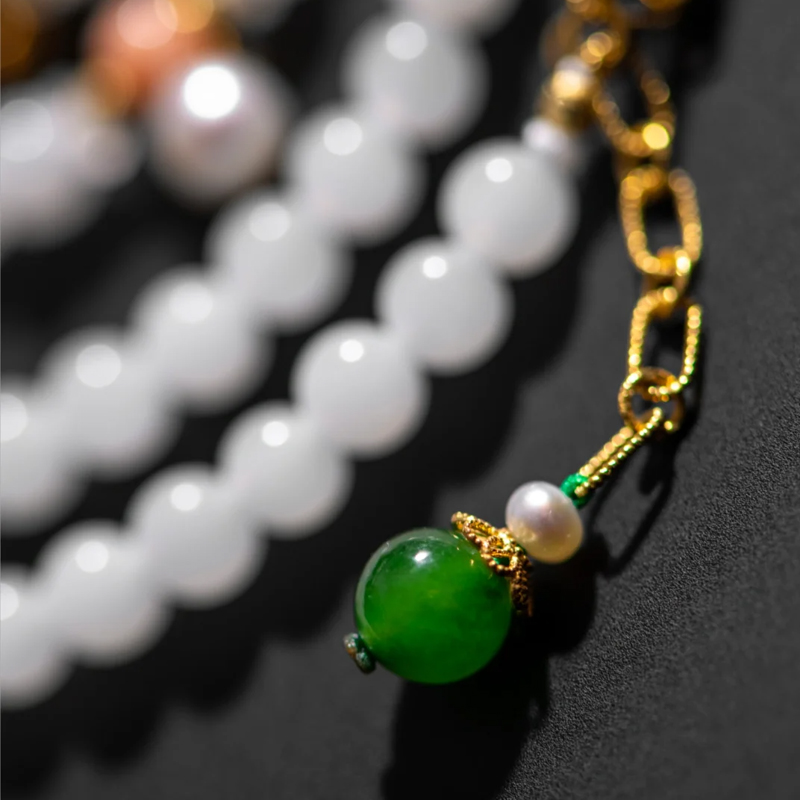
For budgets between 1,000 and 5,000 yuan, consider bracelets made of finely cut white jade, high-quality bi jade, or sugar jade. Most reputable brands’ mid-range product lines fall within this price range. Pay attention to craftsmanship details and the jade’s luster, and choose brands with a solid reputation and comprehensive after-sales service.
For prices above 5,000 yuan, you can consider high-quality Xinjiang jade or collector-grade seed jade bracelets. It is recommended to choose brands with physical retail outlets that allow you to examine the items in person. For high-end products, it is advisable to have them re-inspected by a third-party testing agency after receipt.
Regarding pricing, there is one key point to understand: there is no nationally standardized fixed price per gram or pricing system for Hotan jade. Prices are determined by a combination of factors, including jade quality, origin, craftsmanship, integrity, and market supply and demand. While it is indeed possible to buy a jade bracelet made of Hotan jade for a few hundred yuan, most of these are made from “broadly defined Hotan jade”—such as Qinghai jade or Korean jade—and feature average quality. It is virtually impossible to purchase Xinjiang seed jade or high-quality white jade for a few hundred yuan, so do not expect to find a bargain.
V. The Five Most Common Pitfalls for Beginners
Pitfall 1: Blindly Chasing “Zi Liao”
Nine out of ten beginners who blindly chase “zi liao” will fall into this trap. Not all “zi liao” is expensive, nor is “shan liao” necessarily inferior. The market is flooded with junk “zi liao” full of cracks, cotton-like inclusions, and hardening—selling for just a few dozen yuan per piece—while top-grade “shan liao” commands a higher price than 90% of “zi liao.” For everyday wear, high-quality mountain jade offers the best balance of value, texture, and durability—there’s no need to blindly chase overpriced seed jade.
Be especially wary of the “mountain jade imitating seed jade” scam—where low-quality jade from Qinghai or Korea is processed through drum polishing and chemical dyeing to mimic Hotan jade seed jade. The China Consumers’ Association has repeatedly called out this standardized counterfeiting process, which involves “fake pores created by tumbler sandblasting, fake skin color from chemical dyeing, and fake certificates from unaccredited sources.”
Pitfall 2: Focusing Only on Whiteness, Not Oiliness
Many beginners fall into the misconception that “the whiter, the more valuable.” In reality, the core of Hotan jade’s quality lies in its fine texture and oily luster. Whiteness is merely one aspect of color. It’s better to choose an oily, greenish-white jade than a dry, white one.
Pitfall 3: Relying on Certificates Without Verification
Every product from a legitimate brand comes with an authentication certificate certified by CMA and CNAS. However, there is a possibility of certificate duplication or forgery. When verifying, don’t just scan the QR code provided by the seller; instead, go to the testing agency’s official website, enter the certificate number, and check whether the certificate photo, weight, and the actual item match exactly. For valuable items, it’s recommended to have them re-inspected at a third-party institution yourself.
It’s important to note that certificates only verify material properties; they do not indicate origin or grade. Do not judge quality based solely on the presence of a certificate.
Pitfall 4: Deceptive Live-Stream Lighting
Under the glare of spotlights in live-streaming studios, a filter-like effect can enhance the luster of Hetian jade and conceal flaws. When purchasing, ask the seller to display the Hetian jade under natural light and carefully review the product description. It’s best to ask the seller to record a video of the item under natural light, focusing on whether the surface of the beads exhibits a moist, creamy luster.
Pitfall 5: Chasing Bargains
The root cause of many scams lies in greed—the desire to get the best product for the least amount of money. “Mutton-fat jade nuggets” priced at several thousand yuan and so-called “factory-direct” low-priced Hotan jade are, in essence, carefully designed traps.
VI. How to Inspect Your Purchase Upon Receipt: Three Simple Steps
Step 1: Use a 10x jewelry loupe or your phone’s macro mode to inspect the area around the bead holes, as this is where cracks are most likely to be hidden.
Step 2: Shine a flashlight at a 45-degree angle from the side to reveal the natural, cloud-like internal structure. If the internal structure is particularly loose or grainy, it will affect both the oiliness and fineness of the jade. Conversely, be wary of pieces with absolutely no internal structure—they may be glass or quartzite imitations.
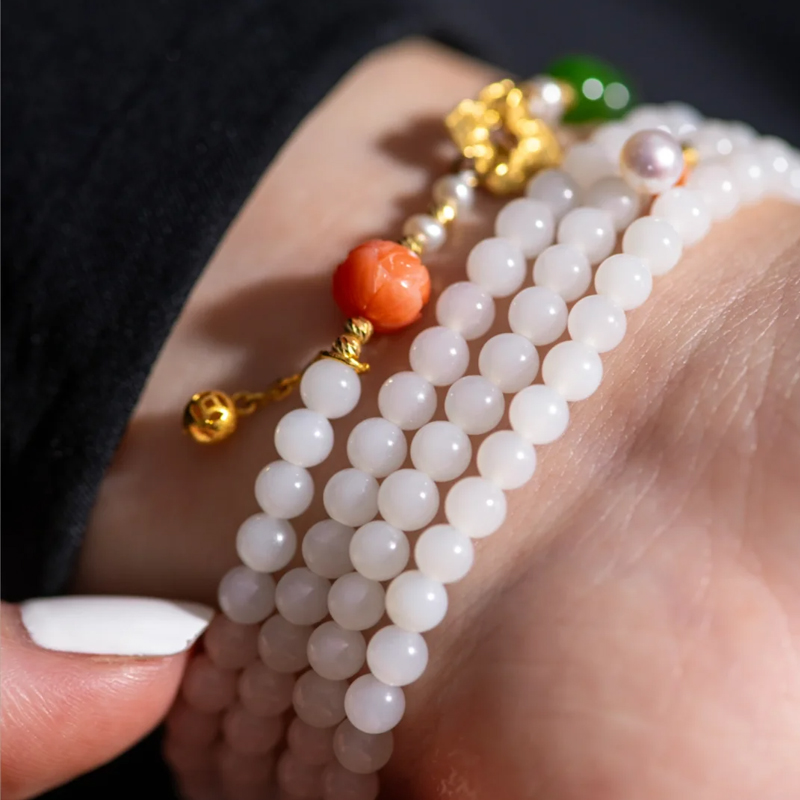
Step 3: Be reasonably tolerant of minor imperfections. Natural jade is never absolutely perfect, especially in bracelets. Minor water lines or pinhead-sized cloud spots are acceptable as long as they do not affect the bracelet’s durability or overall appearance. So-called “flawless” pieces are either exorbitantly priced or suspect.
Focus on jade quality, not origin; prioritize oiliness and luster over whiteness; don’t be tempted by low prices or “bargains”—instead, check the details of the complete certification set. Hotan jade is by no means a mysterious or esoteric subject; don’t let all that mumbo jumbo intimidate you. By focusing on these core elements—oiliness, bead diameter, craftsmanship, and certification—even beginners can purchase a satisfying, high-quality bracelet.